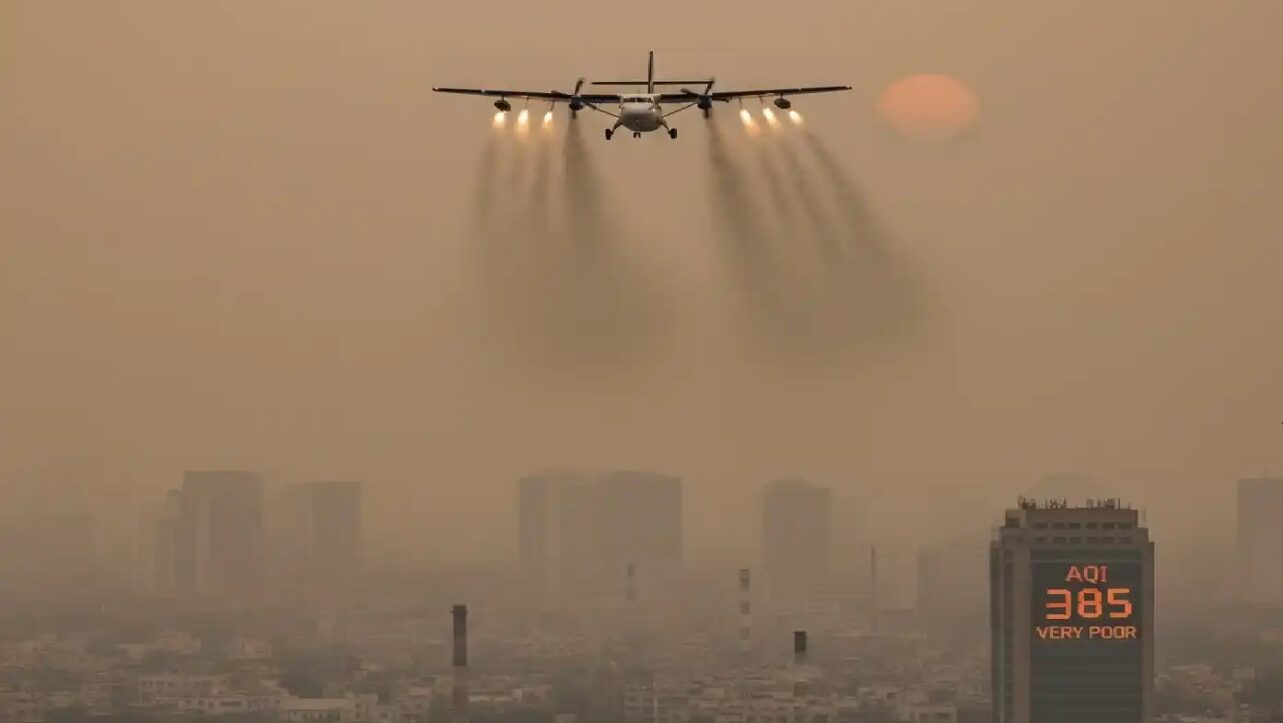
Delhi’s ambitious attempt to combat its toxic air crisis through artificial rain ended in spectacular failure on October 28, 2025, when a ₹1.2 crore cloud seeding experiment produced no measurable rainfall despite two separate trials over the smog-choked capital. The Air Quality Index (AQI) remained locked in the “very poor” to “severe” category even after aircraft dispersed silver iodide flares across northwest Delhi, marking yet another disappointment in the city’s decades-long battle against winter pollution.
The Experiment That Fizzled
A small Cessna aircraft operated by IIT Kanpur conducted two cloud seeding sorties on Tuesday, October 28, hovering over northwest Delhi and parts of the National Capital Region while firing 16 silver iodide and sodium chloride flares—eight in each trial. The targeted areas included Burari, Mayur Vihar, Karol Bagh, Noida, Badli, and surrounding neighborhoods where pollution levels had reached hazardous levels following Diwali celebrations.
The two trials cost approximately ₹1.28 crore, with the aircraft traveling over 400 kilometers from Kanpur to Delhi. This represents a staggering cost of roughly ₹1 lakh per square kilometer for the experimental weather modification attempt.
Despite the elaborate operation coordinated between the Delhi government, IIT Kanpur, the India Meteorological Department (IMD), and the Directorate General of Civil Aviation (DGCA), not a single drop of rain fell over most of Delhi. Some government reports claimed “trace precipitation” of 0.1-0.2 mm at the Delhi-Noida border, but residents and media observers reported no visible rainfall anywhere in the city.
Why the Science Failed
The primary reason for failure was atmospheric conditions entirely unsuitable for cloud seeding. According to Professor Manindra Agrawal, Director of IIT Kanpur, the cloud moisture content hovered at just 10-15%, whereas successful cloud seeding typically requires moisture levels of 50-60% or higher.
“The moisture content remained low at 10-15%, which is not an ideal condition for cloud seeding,” stated the official IIT Kanpur report.
Dr. Akshay Deoras, a research scientist at the UK’s University of Reading, explained to India Today that winter clouds over Delhi are fundamentally unsuitable for seeding: “Just because there are clouds doesn’t mean they are suitable. In winter, cloud seeding should ideally be done only when suitable rain-bearing clouds appear—typically during western disturbances“.
The cloud base altitude also posed challenges. Skymet Weather’s analysis emphasized that clouds near 10,000 feet altitude make seeding far more difficult, whereas the technique works more effectively when cloud bases are below 5,000 feet—conditions not present during the Delhi trials.
The Science Behind Cloud Seeding
Cloud seeding works by introducing tiny particles—typically silver iodide or sodium chloride—into moisture-rich clouds to trigger condensation. Silver iodide has a crystalline structure similar to ice, allowing it to act as “seeds” around which water droplets form. When enough droplets gather, they become heavy enough to fall as precipitation.
Under optimal conditions with adequate atmospheric moisture, studies show cloud seeding can boost rainfall by 5-15%. India’s own CAIPEEX programme over drought-prone Maharashtra recorded rainfall increases of up to 46% on seeded days when conditions were favorable. Countries like China, the UAE, Indonesia, Malaysia, regularly conduct successful cloud-seeding operations for agriculture, smog control, or event management.
However, these successes require specific atmospheric conditions that simply didn’t exist over Delhi on October 28.
Political Controversy and Cost Concerns
The failed experiment immediately sparked political controversy. The Aam Aadmi Party (AAP), which led Delhi’s previous government, criticized the current BJP-led administration, sarcastically asking “whether rain gods will come down to clarify if the city will receive showers“.
Delhi Environment Minister Manjinder Singh Sirsa defended the trials, calling them an “unprecedented, science-first step” and claiming they showed “scientific progress“. He announced plans for nine to ten more trials in coming days if atmospheric conditions improve, stating: “Our focus is to assess how much rainfall can be triggered under Delhi’s real-life humidity conditions”.
However, the ₹3.21 crore budget allocated for just five cloud seeding trials—roughly ₹64 lakh per attempt—has raised questions about cost-effectiveness. Critics point out that this expensive gamble was undertaken despite expert warnings that winter conditions in Delhi are fundamentally unsuitable for cloud seeding.
The project had already faced multiple delays. Initially planned for late May and early June 2025, the trials were first postponed to late August-September due to the southwest monsoon, then delayed again as rains persisted in the region.
Delhi’s Toxic Air Emergency
The failed cloud seeding experiment comes as Delhi faces its worst post-Diwali air quality in four years. On October 28, the city’s AQI fluctuated between 300 and 400—nearly 20 times higher than the safe threshold recommended by health authorities.
AQI measures the concentration of PM2.5 particles—fine particulate matter small enough to penetrate deep into lungs and enter the bloodstream, causing severe respiratory and cardiovascular damage.
Health Crisis Deepens
Doctors across Delhi report an alarming surge in respiratory emergencies since Diwali:
Most Vulnerable Populations:
- Children under 5 years old, whose developing lungs are particularly susceptible to particulate matter damage
- Elderly individuals over 60 with pre-existing respiratory or cardiac conditions
- Pregnant women, who face increased risks of pregnancy complications and fetal development issues
- Individuals with asthma, COPD, bronchitis, or heart disease
Reported Health Impacts:
- Dramatic increase in emergency room visits for asthma attacks
- Surge in bronchitis and chronic cough cases
- Widespread reports of burning eyes, throat irritation, and breathing difficulties
- Rising heart attack and stroke admissions linked to air pollution exposure
- Worsening outcomes for lung disease patients
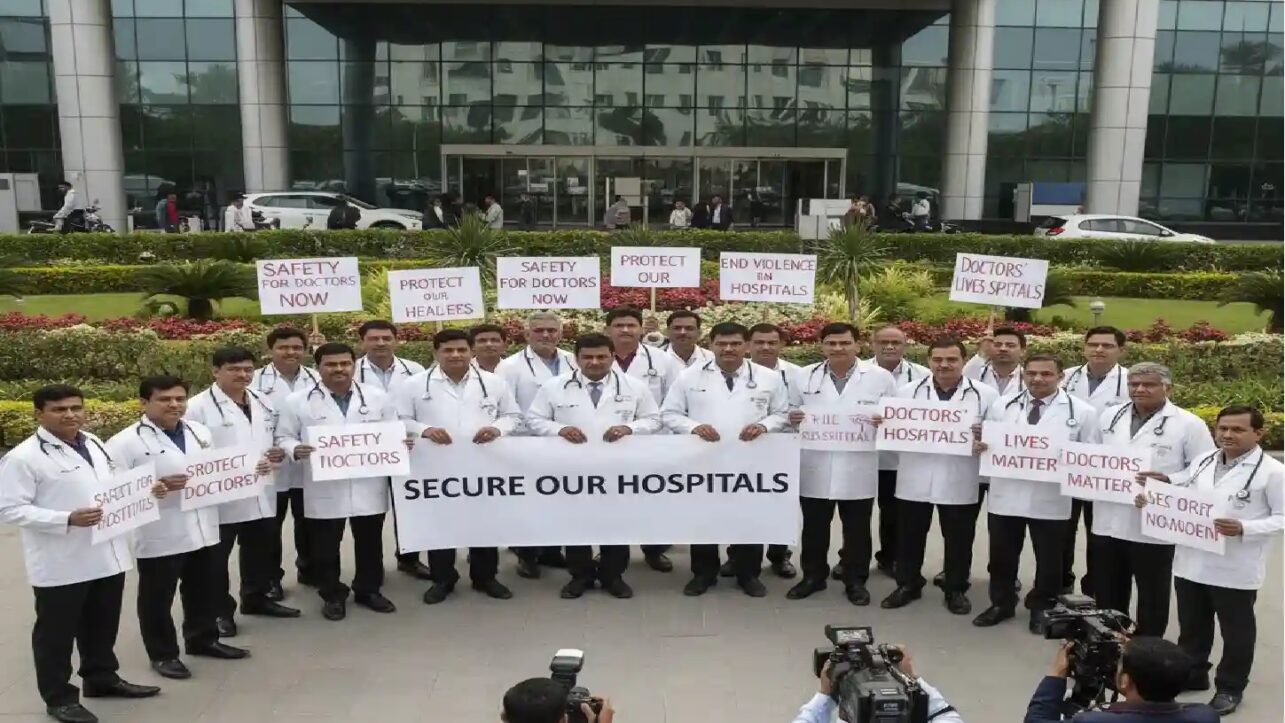
Delhi’s hospitals have been overwhelmed with patients suffering pollution-related illnesses, with pediatric wards seeing particularly high admissions of children with severe respiratory distress.
Expert Warnings: Not a Long-Term Solution
Even if future cloud seeding attempts succeed in producing rainfall, experts emphasize this represents only a temporary “band-aid” solution rather than addressing Delhi’s chronic pollution crisis.
Professor Agrawal called cloud seeding a temporary “SOS measure” rather than a comprehensive solution to Delhi’s systemic air quality challenges. The BBC reported widespread skepticism among specialists regarding cloud seeding’s effectiveness as a sustainable pollution control strategy.
Environmental expert Chandra Bhushan told Times Now: “You can’t treat a lung by cleaning one nostril“—emphasizing that Delhi’s pollution requires an “airshed approach” addressing all emission sources across the entire Indo-Gangetic Plain, not quick-fix weather manipulation in one city.
The root causes of Delhi’s toxic air—stubble burning in neighboring Punjab and Haryana, vehicle emissions, construction dust, industrial pollution, and coal-fired power plants—remain entirely unaddressed by cloud seeding experiments.
Historical Context: Decades of Failed Attempts
This isn’t Delhi’s first failed cloud seeding experiment. The city attempted similar weather modification trials in 1957 and again in the 1970s, both of which produced negligible results. Seven decades later, Delhi still cannot summon rain on demand.
The current experiment represents the capital’s first cloud seeding attempt in approximately half a century, undertaken with more sophisticated technology but facing the same fundamental atmospheric limitations.
What Happens Next?
Despite Tuesday’s failure, Delhi’s Environment Minister announced that additional trials would proceed “over the next few days” when wind direction favors northern areas and if atmospheric moisture levels increase. Up to ten total trials are now planned, though dates depend on favorable meteorological conditions that may never materialize during Delhi’s dry winter season.
Wednesday’s planned cloud seeding trial was already shelved due to continued unfavorable atmospheric conditions.
Meanwhile, Delhi’s 20 million residents continue breathing hazardous air with no relief in sight. The government’s ₹3.2 crore investment in experimental weather modification stands in stark contrast to the absence of aggressive action on stubble burning enforcement, vehicle emission controls, or industrial pollution regulation—the actual sources of Delhi’s annual winter smog crisis.
The Verdict
Delhi’s ₹1.2 crore cloud seeding experiment represents an expensive gamble on unproven technology rather than addressing the systemic causes of the capital’s air pollution crisis. With atmospheric conditions fundamentally unsuitable for weather modification during winter months, the trials were likely doomed from the start—a fact that raises questions about due diligence in approving the multi-crore project.
As one atmospheric scientist told Times of India: “You can’t seed what isn’t there.” Until Delhi and neighboring states tackle stubble burning, vehicle emissions, and industrial pollution at their source, no amount of silver iodide can wash away the capital’s toxic air.