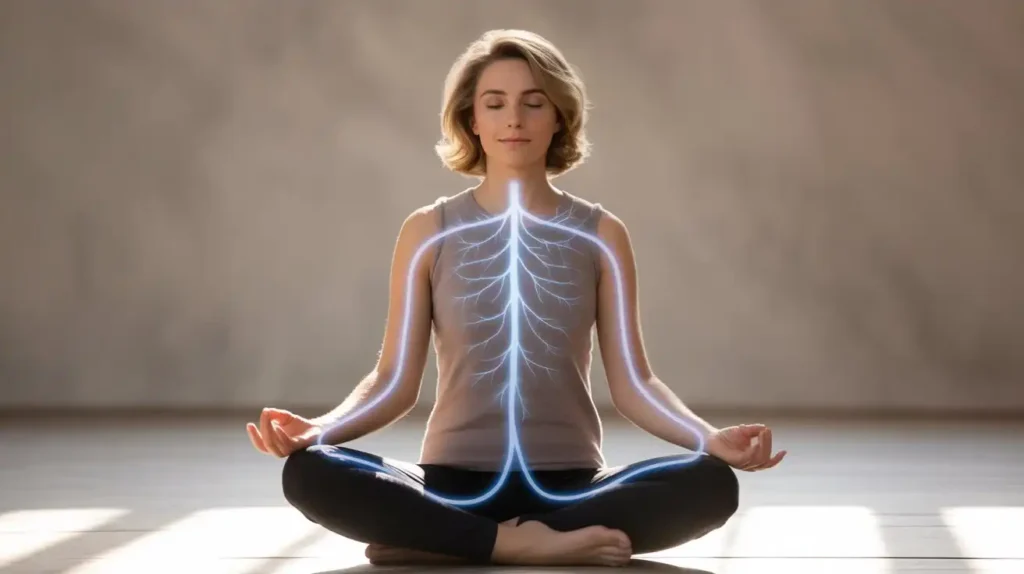
Modern neuroscience is uncovering what yogic traditions have long known: the vagus nerve holds remarkable power over physical and mental wellbeing. This cranial nerve serves as a bidirectional superhighway connecting the brain to vital organs throughout the body, regulating everything from heart rate and digestion to immune function and emotional wellbeing.
This comprehensive guide explores the scientific mechanisms behind vagal nerve stimulation through yoga, presenting evidence-based research on how specific asanas mechanically activate vagal pathways through chest opening, throat compression, and spinal extension. The article details practical pranayama techniques along with the application of bandhas (energy locks) that directly stimulate the vagus nerve through targeted muscle engagement. Readers will find step-by-step practice instructions along with videos for each technique, supported by recent studies demonstrating measurable improvements in heart rate variability, stress reduction, and parasympathetic nervous system activation.
The science of vagus nerve and yoga
Understanding the Vagus Nerve
The vagus nerve, also known as cranial nerve X, is the longest nerve in the human body, extending from the brainstem through the neck and thorax down to the abdomen. As the primary component of the parasympathetic nervous system, it contains both motor and sensory functions in afferent and efferent pathways. The nerve innervates multiple organs including the heart, lungs, digestive tract, and throat, making it a crucial regulator of internal organ functions.
Approximately 80% of vagal nerve fibers are sensory, carrying information from organs to the brain, while 20% are motor fibers transmitting signals from brain to organs. This bidirectional communication facilitates the gut-brain axis, where trillions of bacteria in the digestive system communicate with the brain to regulate bodily functions.
The Science of Vagal Tone
Vagal tone refers to the activity level of the vagus nerve and is measured through heart rate variability (HRV) – the variation in time intervals between heartbeats. High vagal tone is associated with greater stress resilience, improved emotional regulation, better cognitive function, and enhanced physiological flexibility. Conversely, low vagal tone correlates with increased stress reactivity, chronic inflammation, depression, anxiety, and reduced ability to recover from stress. Research demonstrates that high vagally mediated resting-state is associated with superior working memory function, shorter reaction times, higher accuracy, and more efficient neural resource utilization in the prefrontal cortex. .
Yoga’s Impact on Vagal Tone: The Research Evidence
A landmark 2016 comprehensive review by Tyagi and Cohen found that despite methodological limitations in early studies, yoga practices significantly affect cardiac autonomic regulation with increased HRV and vagal dominance during practice. Regular yoga practitioners demonstrated increased vagal tone at rest compared to non-practitioners.
A 2018 neurophysiological model of respiratory vagal stimulation published in journal-Frontiers in Human Neuroscience explains how specific respiration styles phasically and tonically stimulate vagal afferents through respiratory modulation, providing a mechanistic understanding of pranayama’s therapeutic effects.
The Yogic Pathway to Vagal Activation
Yoga may directly stimulate the vagus nerve through multiple mechanisms:
Mechanical Stimulation: Postures that compress, stretch, or open the abdomen, chest, and neck regions where the vagus nerve travels provide direct physical stimulation.
Respiratory Modulation: Slow, controlled breathing with emphasis on lengthening the exhalation stimulates nerve fibers in the lungs to initiate parasympathetic responses.
Diaphragmatic Engagement: Deep diaphragmatic breathing massages digestive organs and activates vagal pathways, particularly when engaging abdominal muscles during complete exhalation.
Yoga Asanas for Vagus Nerve Activation
Bhujangasana (Cobra Pose)
Cobra Pose is a fundamental backbend that creates a powerful stretch through the entire front of the body, particularly opening the chest and throat where vagal pathways travel. This heart-opening asana stimulates the vagus nerve through mechanical stretching of the anterior neck region where the nerve travels superficially beneath the skin. The expansion of the chest in Cobra Pose improves lung capacity and respiratory function, enhancing oxygenation while promoting deep, diaphragmatic breathing that activates parasympathetic responses.
Practice Instructions:
- Lie on stomach with toes flat on floor, forehead resting on ground, and legs close together.
- Place palms flat on floor under shoulders with elbows parallel and close to torso.
- Inhale deeply and slowly lift head, chest, and abdomen while keeping navel on floor.
- Pull torso back and off floor with support of hands, curving spine vertebra by vertebra.
- Straighten arms (or keep slight bend in elbows) and arch back, tilting head back to gaze upward.
- Keep shoulders relaxed away from ears and press evenly through both palms.
- Hold pose for 15-30 seconds while breathing evenly for 4-5 breaths.
- Exhale and gently lower abdomen, chest, and head back to floor in reverse order.
- Rest with head turned to one side, then repeat 3-5 times.
Vagus Nerve Benefits:
Opens the chest and throat regions, stretches vagal pathways in the anterior neck, stimulates parasympathetic activation through improved respiratory function, and releases stagnant energy in the heart center.
Ustrasana (Camel Pose)
Camel Pose is an intermediate-level backbend that creates a profound opening across the entire front body, particularly the chest, abdomen, and throat. The deep opening of the chest and throat in Ustrasana directly stimulates the vagus nerve, which plays a key role in activating the parasympathetic “rest and digest” nervous system. When this system is engaged, breathing naturally slows and deepens, heart rate decreases, anxiety levels reduce, and oxygen utilization improves.
Practice Instructions:
- Kneel on mat with knees hip-width apart and feet pointing back, place hands on hips.
- Engage lower belly and draw tailbone toward knees to create space in lower back.
- Inhale, lift sternum upward and draw elbows back toward each other to open chest.
- Keep chest lifted and core engaged as you reach hands back toward heels one at a time.
- Press palms into heels with fingers draped over soles (or keep hands on hips for modification).
- Gently allow head and neck to drop backward while maintaining lift through sternum.
- Hold for 30-60 seconds while breathing steadily.
- To exit, bring chin to chest, place hands on hips with thumbs on sacrum, and slowly come back up to kneeling position using core strength.
Vagus Nerve Benefits:
Deeply stimulates the vagus nerve through chest and throat opening, activates parasympathetic responses leading to slower breathing and reduced heart rate, reduces anxiety and promotes emotional balance, enhances lung capacity and oxygenation.
Dhanurasana (Bow Pose)
Bow Pose creates a powerful full-body stretch that simultaneously opens the chest and throat while strengthening the back muscles. Named after the archer’s bow shape the body creates, this asana provides mechanical stimulation to vagal pathways in the chest and throat regions. The pose massages internal organs including the liver, kidneys, pancreas, and adrenal glands while improving blood circulation throughout the body.
Practice Instructions:
- Lie on stomach with arms beside body and feet hip-width apart.
- Bend knees and bring heels close to buttocks, reach back and hold ankles with hands.
- Inhale deeply, then lift chest and thighs off the ground while pulling feet backward and upward.
- Keep arms straight and use backward leg movement to deepen the arch, gaze forward or slightly upward.
- Hold for 15-30 seconds while breathing deeply, keeping body curved like a bow.
- Exhale slowly, release ankles, and gently lower chest and legs back to the ground.
- Rest in prone position for a few breaths before repeating 2-3 times.
Vagus Nerve Benefits:
Opens chest and throat for vagal stimulation, enhances respiratory function and lung capacity, massages digestive organs stimulating vagal pathways to the gut, improves blood circulation which supports vagal tone, reduces stress and tension.
Setu Bandhasana (Bridge Pose)
Bridge Pose activates the ventral vagus nerve, promoting relaxation and reducing stress responses. This gentle backbend creates space in the chest while providing mild inversion benefits, making it accessible for most practitioners. The pose strengthens the back, glutes, and hamstrings while opening the chest, throat, and hip flexors.
Practice Instructions:
- Lie on back with knees bent and feet flat on mat, hip-width apart, heels close to buttocks.
- Place arms beside body with palms facing down.
- Press feet firmly into floor and lift hips, lower back, and upper back off the mat.
- Roll shoulders under and bring chest toward chin without dropping chin down.
- Keep thighs parallel to each other and to the floor, feet and knees aligned.
- Hold for 30 seconds to 2 minutes while breathing deeply.
- To exit, slowly lower spine vertebra by vertebra back to mat and relax.
Vagus Nerve Benefits:
Activates the ventral vagus nerve by openening the chest and throat, improves circulation which supports vagal function, reduces stress and anxiety through parasympathetic activation.
Adho Mukha Svanasana (Downward-Facing Dog)
This foundational pose lengthens the entire torso and spine while creating a mild inversion effect, encouraging blood flow towards the brain and heart. As one of the most recognized yoga poses, Downward-Facing Dog provides whole-body benefits while remaining accessible to most practitioners.
Practice Instructions:
- Start on hands and knees in tabletop position with wrists aligned under shoulders and knees under hips.
- Spread fingers wide and press palms firmly into the mat, especially base of index fingers.
- Curl toes under and lift hips up and back, straightening legs to form an inverted V-shape.
- Press heels toward the floor while keeping spine straight and lengthening through the tailbone.
- Engage quadriceps to straighten legs (keep slight bend in knees if hamstrings are tight).
- Draw shoulder blades down toward hips and away from ears, rotating upper arms outward.
- Let head hang naturally between arms, keeping neck relaxed and gaze toward feet or navel.
- Hold for 5-10 breaths (30 seconds to 3 minutes depending on experience level).
- To exit, bend knees and lower back down to tabletop position, then rest in Child’s Pose.
Vagus Nerve Benefits:
Downward Facing Dog stimulates the vagus nerve through its mild inversion, where the heart is positioned above the head, enhancing blood flow to the brain and promoting parasympathetic nervous system activation. The gentle compression of the abdomen combined with deep diaphragmatic breathing in this pose directly massages the vagal pathways, supporting digestive function and reducing stress hormones.
Salamba Sarvangasana (Supported Shoulder Stand)
Shoulder Stand is considered the “queen of asanas” due to its profound effects on multiple body systems. This advanced inversion mechanically stimulates the vagus nerve through altered blood flow and gentle compression in the neck region where the nerve travels. The chin lock (Jalandhara Bandha) created naturally in this pose provides direct vagal stimulation. This pose should only be practiced under expert guidance, especially for beginners.
Practice Instructions:
- Lie on back with arms by sides, palms facing down.
- Lift legs, buttocks and back in one movement to come up high on shoulders.
- Support back with hands, walk elbows closer together and move hands up toward shoulder blades.
- Straighten legs and spine, bringing toes over nose, keeping weight on shoulders and upper arms (not neck).
- Hold for 30 seconds to 5 minutes while breathing deeply, maintaining sternum pressed toward chin.
- To exit, lower knees to forehead, place hands on floor palms down, slowly lower spine vertebra by vertebra.
- Lower legs to floor and relax for minimum 60 seconds before repeating.
Vagus Nerve Benefits:
Direct mechanical stimulation of vagus nerve through gentle neck compression, chin lock (Jalandhara Bandha) activates vagal pathways, increased blood flow towards heart and neck enhances parasympathetic responses, calms nervous system and reduces stress.
Supta Konasana (Reclining Bound Angle Pose)
Reclining Angle Pose is a deep restorative posture that opens the inner thighs, groins, and hamstrings while promoting profound relaxation. The pose is particularly beneficial for digestive health, pelvic circulation, and nervous system calming.
Practice Instructions:
- Lie on back with legs and arms extended straight on floor.
- Inhale and swing legs overhead until toes touch floor behind head (similar to Halasana/Plow Pose).
- Reach arms overhead to grasp big toes with corresponding hands (thumb, index and middle fingers wrapping around toes).
- Exhale and separate legs as wide as possible while keeping grip on toes, maintaining inverted spine erect.
- Hold for 20-30 seconds while breathing deeply, keeping legs straight and spread wide.
- Release grip on toes, bring legs back together, and slowly lower spine and legs back to floor.
- Rest in resting position before repeating.
Vagus Nerve Benefits:
Opens the abdomen and pelvic region for vagal pathway stimulation in those areas., provides vagus nerve stimulation through jalandhar bandha (compression of carotid sinus and jugular veins in neck region). This pose increases blood supply to neck promoting deep parasympathetic activation. It supports digestive function through vagal influence on the gastrointestinal system, creating a deeply calming effect on the nervous system and facilitates tension release from the lower back, hips, and inner leg regions.
Viparita Karani (Legs-Up-The-Wall Pose)
Legs-Up-The-Wall is a gentle, accessible restorative inversion that provides vagus nerve stimulation benefits without the intensity or risks of full inversions. This deeply calming pose relieves fatigue, reduces swelling in legs and feet, improves circulation (both lymphatic and venous), and supports the nervous system. The mild inversion encourages parasympathetic activation while remaining safe and comfortable for most practitioners.
Practice Instructions:
- Sit sideways next to wall with right hip against it, then lower shoulders and head to floor.
- Roll onto back and extend legs up the wall, keeping them straight and relaxed.
- Scoot hips closer to wall until body forms L-shape with legs fully supported.
- Place arms comfortably at sides with palms facing up, relax completely.
- Hold for 5-20 minutes while breathing naturally and deeply.
- To exit, bend knees toward chest, roll to one side, rest briefly, then use arms to push up to seated position.
Vagus Nerve Benefits:
This gentle inversion sends calming signals through the vagus nerve by promoting blood flow from the legs toward the heart and brain, reversing the effects of gravity and activating the body’s natural relaxation response. The sustained hold in this restorative position allows for profound parasympathetic stimulation, improving digestive function, enhancing emotional regulation, and supporting overall nervous system health through consistent practice.
Integrating Bandhas (Energy Locks)
The three primary bandhas – Mula Bandha (root lock), Uddiyana Bandha (abdominal lock), Jalandhara Bandha (throat lock), along with Maha Bandha (combination of all three bandhas) – stimulate the vagus nerve through engagement of muscles surrounding the neck and vagal pathways.
Jalandhara Bandha (throat lock) specifically involves gentle compression of the carotid sinuses and jugular veins in the neck where the vagus nerve travels, providing direct mechanical stimulation. This bandha is naturally created in Shoulder Stand and can be consciously engaged in seated pranayama practices.
Uddiyana Bandha (abdominal lock) involves drawing the abdomen in and up, creating gentle compression of digestive organs innervated by the vagus nerve. This engagement stimulates the gut-brain axis through vagal pathways.
Mula Bandha (root lock) involves subtle engagement of the pelvic floor muscles, supporting overall nervous system regulation and grounding.
Practice Instructions:
Jalandhara Bandha (Throat Lock):
- Sit cross-legged with spine erect, hands on knees.
- Inhale deeply, lift chest, then hold breath in.
- Lower chin to rest in notch between collarbones while lifting sternum toward chin.
- Hold comfortably, then release chin and exhale slowly.
- Relax 30-60 seconds, repeat 3-5 rounds.
Uddiyana Bandha (Abdominal Lock):
- Sit cross-legged with spine erect, hands on knees.
- Exhale completely, hold breath out.
- Pull abdomen in and up toward spine, creating hollow under ribcage.
- Hold comfortably without straining, then release and inhale slowly.
- Take 2-3 normal breaths between rounds, practice 3-5 rounds.
Mula Bandha (Root Lock):
- Sit in meditation posture with spine erect.
- Contract and lift pelvic floor muscles (between anus and genitals) upward and inward.
- Hold subtle contraction while breathing normally or during breath retention.
- Keep contraction gentle without tensing buttocks or thighs.
- Release slowly and relax completely.
Maha Bandha (Great Lock):
- Sit cross-legged (Padmasana) with hands on knees.
- Inhale deeply, exhale completely, hold breath out.
- Engage Jalandhar Bandha, then Uddiyana Bandha, then Mula Bandha.
- Hold all three locks simultaneously for comfortable duration.
- Release in reverse order: pelvic floor, abdomen, pelvic chin, then inhale slowly.
- Breathe normally for several breaths, repeat 3-5 rounds.
Vagus Nerve Benefits:
The bandhas (yogic locks) are powerful techniques that directly stimulate the vagus nerve and activate the parasympathetic nervous system through their strategic placement along the vagal pathways. Jalandhara Bandha (throat lock) applies gentle compression to the throat region where the vagus nerve passes, stimulating parasympathetic activation that slows heart rate, reduces blood pressure, and promotes deep mental relaxation while also supporting thyroid function and reducing stress and anxiety.
Uddiyana Bandha (abdominal lock) creates direct vagal stimulation by applying pressure to the vagus nerve in the abdominal region, strengthening and toning the parasympathetic nervous system while improving digestion, increasing blood circulation to the brain, and creating a calming effect on the entire nervous system. Mula Bandha (root lock) corresponds with the sacral plexus at the lower aspect of the parasympathetic nervous system, working synergistically with the other bandhas to enhance energy regulation and nervous system balance.
Maha Bandha (the great lock), which combines all three bandhas simultaneously, provides the most comprehensive vagal stimulation by engaging the entire parasympathetic pathway from the pelvic floor through the abdomen to the throat, offering profound benefits for nervous system regulation, mental clarity, emotional balance, and overall mind-body integration. Research confirms that these practices trigger reflex increases in vagal tone, leading to enhanced parasympathetic activity, improved cardiovascular regulation, reduction in blood pressure and measurable improvements in heart rate variability.
Pranayama Techniques for Vagal Stimulation
Ujjayi Pranayama (Ocean Breath)
Ujjayi breathing creates slight constriction in the throat by engaging whisper muscles, producing an ocean-like sound. Research demonstrates this practice stimulates the vagus nerve and triggers the relaxation response.
Practice Instructions:
- Exhale through the mouth as if fogging a mirror.
- Close the mouth and breathe through the nose while maintaining throat engagement.
- Start with equal counts for inhalation and exhalation (4:4).
- Gradually extend the exhale to 6-8 counts for deeper parasympathetic activation.
Vagus Nerve Benefits:
Ujjayi Pranayama stimulates the vagus nerve through gentle constriction of the throat, creating direct mechanical activation of vagal fibers that run through the throat and vocal cords. The slow, controlled breathing with extended exhalations activates pulmonary stretch receptors (Hering-Breuer reflex), sending inhibitory signals that calm the sympathetic nervous system.
During practice, Ujjayi produces immediate calming effects. The throat constriction creates audible feedback that helps maintain slow, deep breathing patterns. This activates the parasympathetic nervous system in real-time, promoting relaxation while maintaining alertness.
With regular practice, the benefits compound significantly. A 2017 study found that 3 months of daily Ujjayi practice reduced resting heart rate from 82.40 to 75.84 bpm and significantly decreased blood pressure responses to stress. More recently, a 2025 study showed that just 20 days of Ujjayi practice significantly improved emotional intelligence in participants through enhanced vagus nerve-mediated parasympathetic activity, improving emotional regulation and prefrontal cortex modulation of the amygdala.
The practice creates autonomic equilibrium between sympathetic and parasympathetic systems. By stimulating the vagus nerve consistently, Ujjayi increases parasympathetic tone, reduces inflammatory responses, improves heart rate variability, and enhances the body’s natural relaxation response—making it particularly effective for managing stress, anxiety, and cardiovascular health.
Diaphragmatic Breathing (Yogendra Pranayama 4)
This is considered the most effective way to stimulate the vagus nerve by activating the parasympathetic nervous system.
Practice Instructions:
- Lie supine with knees bent, feet hip-width apart.
- Place one hand on the abdomen near the navel.
- Inhale gently, allowing the abdomen to rise.
- Exhale slowly, engaging diaphragm and abdominal muscles to completely empty lungs.
- This provides gentle massage to digestive organs and stimulates vagal pathways.
Vagus Nerve Benefits:
Yogendra Pranayama 4 is considered the most effective way to directly stimulate the vagus nerve by activating the parasympathetic nervous system through diaphragmatic movement. The slow, rhythmic abdominal breathing creates what researchers call “respiratory vagal nerve stimulation (rVNS)”—the diaphragm’s movement triggers vagal fibers that send immediate calming signals to the brain.
“A 2018 theoretical review published in Frontiers in Human Neuroscience by Gerritsen and Band proposed a neurophysiological model explaining how diaphragmatic breathing stimulates the vagus nerve through both direct pathways (suppressing vagal activity during inhalation, facilitating it during exhalation) and indirect pathways (creating a biofeedback loop where relaxed breathing signals the brain to increase vagal tone further). This mechanism produces immediate physiological effects including lowered heart rate, reduced blood pressure, decreased stress hormones, and increased heart rate variability. The supine position used in Yogendra Pranayama 4 allows maximum diaphragm movement, making it particularly effective for nervous system calming and creating inner quietude and harmony.
Straw Breath (Kaki Pranayama)
This technique provides resistance to the exhalation, training the diaphragm and promoting relaxation.
Practice Instructions:
- Take a gentle inhalation.
- Purse lips as if blowing through a straw.
- Exhale very slowly through pursed lips until lungs are 80% empty.
- Close mouth and exhale remaining 20% through nose while engaging abdominal muscles.
- Allow natural inhalation, take three regular breaths, then repeat 2-3 times.
Vagus Nerve Benefits:
Kaki Pranayama (Straw Breath) stimulates the vagus nerve by creating resistance during exhalation, which trains the diaphragm and activates parasympathetic nervous system responses. The pursed-lip technique slows down exhalation, making it the most direct way to balance the vagus nerve since every exhalation naturally stimulates the parasympathetic system while inhalation engages the sympathetic system.
A 2018 study on COPD patients and healthy individuals found that pursed-lip breathing (straw breath) significantly improved oxygen saturation by 2.05%, decreased respiratory rate by 0.65 breaths per minute, and reduced heart rate by 1.6 bpm (p≤0.05). The study authors concluded that “the stimulation of the autonomic nervous system and parasympathetic activity” through vagus nerve activation “causes relaxation and improvement of physiological parameters”. In healthy subjects, the heart rate decrease was even more pronounced at 3.55 bpm, demonstrating the technique’s effectiveness across different populations.
The resistance created during pursed-lip exhalation stimulates vagal afferents in the airways, creating a biofeedback loop where the relaxed breathing pattern signals the brain to increase vagal tone further. By engaging the diaphragm and abdominal muscles to expel the last 20% of air through the nose after the initial 80% through pursed lips, this technique provides gentle massage to digestive organs while activating vagal pathways. The practice enhances respiratory sufficiency, improves gas exchange, increases tidal volume, and promotes overall nervous system calming—making it particularly effective for managing stress, anxiety, and shallow breathing patterns.
Sheetali and Sheetkari Pranayama (Cooling Breaths)
Sheetali and Sheetkari pranayamas are ancient cooling breath techniques that activate the parasympathetic nervous system through unique oral modifications during inhalation. Sheetali, meaning “cooling” in Sanskrit, involves rolling the tongue into a tube to inhale cool air, while Sheetkari creates a hissing sound by drawing breath through closed teeth. These practices are particularly effective during hot weather or when experiencing emotional heat—anger, irritability, or anxiety—as they induce muscular relaxation, reduce emotional excitation, and activate brain centers associated with temperature regulation and stress reduction. Both techniques provide powerful vagal stimulation by combining slow, deep breathing with specialized oral morphology that enhances parasympathetic activation beyond simple deep breathing alone.
Practice Instructions:
Sheetali Pranayama (Cooling Breath):
- Sit in comfortable cross-legged position (Sukhasana or Padmasana) with spine erect and hands on knees.
- Close eyes and relax the entire body with a few normal breaths.
- Protrude tongue from mouth and roll sides up to form a tube shape.
- Inhale slowly and deeply through the tube-like tongue, feeling the cooling sensation.
- Close mouth at end of inhalation and exhale slowly through nose.
- Repeat for 5-10 minutes daily, focusing on the cooling effect with each breath.
Sheetkari Pranayama (Hissing Breath):
- Sit in comfortable meditative posture with spine straight and eyes closed.
- Press lower and upper teeth together gently, separate lips to expose teeth.
- Inhale slowly through gaps in teeth, listening to the soft hissing sound produced.
- Close mouth at end of inhalation and exhale slowly through nose.
- Repeat for 5-10 minutes daily, maintaining awareness of the cooling breath.
Vagus Nerve Benefits:
Sheetali and Sheetkari pranayamas stimulate the vagus nerve through specialized oral morphology—tongue rolling in Sheetali and teeth exposure in Sheetkari—creating additional vagal activation beyond conventional slow breathing, potentially through enhanced facial and oropharyngeal mechanoreceptors connected to vagal pathways via glossopharyngeal nerves in nucleus tractus solitarii in the brain
A 2017 randomized controlled trial published in Integrative Medicine (60 hypertensive patients, 30 days) demonstrated systolic blood pressure, heart rate reduction and respiratory rate reduction indicating enhanced parasympathetic vagal tone.
A 2021 crossover clinical trial found externally-paced Sheetali/Sheetkari (6 breaths/minute) produced greater increases in RMSSD—a key parasympathetic HRV marker—compared to sitting quietly.
An October 2025 study showed Sheetali and Sheetkari produced the most substantial increases in parasympathetic activity, with significant improvements RMSSD. EEG analysis revealed increased Beta and Gamma waves (alertness) alongside decreased Delta waves (relaxation), demonstrating simultaneous mental clarity and deep relaxation through vagal activation.
A 2020 randomized controlled trial confirmed Sheetali significantly reduces blood pressure in hypertensive patients and improves heart rate variability through sympathovagal nervous system modification. The blood pressure reduction is attributed to predominant vagal tone following slow-breathing combined with evaporative cooling during tongue rolling, sending additional inhibitory signals through vagal afferents.
Kapalabhati Pranayama (Skull Shining Breath)
Kapalabhati, meaning “skull shining breath,” is a vigorous cleansing technique (kriya) that stimulates the vagus nerve through rhythmic diaphragmatic engagement and mechanical stimulation of pulmonary stretch receptors. This ancient practice has been used in Indian yoga traditions for centuries to enhance prana (life force), clear the energy channels (nadis), and activate parasympathetic responses.
Practice Instructions:
- Sit in comfortable cross-legged position with spine erect and hands on knees, palms facing upward.
- Take a deep inhalation through both nostrils to fill lungs completely.
- Exhale forcefully and rapidly by pulling navel back toward spine, contracting abdominal muscles to expel air through nose.
- Allow passive, automatic inhalation by simply relaxing abdominal muscles—breath flows in naturally without effort.
- Complete 20-30 forceful exhalations as one round.
- Close eyes and breathe normally for 30-60 seconds between rounds, then repeat for 2-3 rounds total.
Vagus Nerve Benefits:
Kapalabhati stimulates vagal afferents through mechanical activation of pulmonary stretch receptors during rapid exhalations. This creates oscillatory patterns that influence the nucleus tractus solitarius (NTS), modulating neuroendocrine activity and promoting the release of oxytocin and vasopressin for autonomic stability and emotional regulation. The practice enhances respiratory function, increases oxygenation, stimulates the sympathetic nervous system during active phase followed by parasympathetic activation during rest periods, and supports the gut-brain axis through stimulation of abdominal organs.
A Systemic Review published in Annals of Neurosciences reveals that during Kapalabhati practice, rapid exhalations stimulate brainstem regions, relaying sensory information via the vagus nerve to the nucleus tractus solitarius (NTS), a critical hub for autonomic regulation. The forceful exhalations activate pulmonary stretch receptors, baroreceptors, and vagal afferents, all converging at the NTS to modulate neuroendocrine responses. This creates excitatory projections to the paraventricular nucleus (PVN) and supraoptic nucleus (SON) of the hypothalamus, promoting the release of oxytocin and vasopressin—neuropeptides associated with autonomic stability, emotional regulation, and respiratory modulation.
A 2020 study examining the acute effect of Kapalabhati on cardiac autonomic function found that the practice influences autonomic tone to the heart through changes in respiratory rate, which can bring about changes in cardiovascular parameters via the closely associated respiratory and cardiovascular centers in the brainstem.
Bhastrika Pranayama (Bellows Breath)
Bhastrika Pranayama, known as “Bellows Breath” or “Breath of Fire,” is a vigorous breathing technique that mimics the action of a blacksmith’s bellows. This powerful practice involves rapid, forceful inhalations and exhalations that stimulate the vagus nerve through rhythmic diaphragmatic engagement and activation of respiratory centers in the brainstem. Unlike Kapalabhati where only the exhalation is forceful, in Bhastrika both inhalation and exhalation are equally forceful and active.
The vigorous breathing pattern in Bhastrika generates internal heat (agni), clears energy blockages in the nadis (energy channels), and powerfully activates both sympathetic and parasympathetic nervous systems, ultimately promoting balance and vitality.
Practice Instructions:
- Sit in vajrasana or sukhasana with spine erect, make fists and fold arms near shoulders with elbows close to waist.
- Take a deep inhalation through nose to prepare the body.
- Exhale forcefully and rapidly through nose while bringing arms down to shoulder level and closing fists.
- Immediately inhale forcefully and rapidly through nose while raising arms straight up and opening fists.
- Continue rapid forceful inhalation and exhalation for 10-20 breaths as one round (both inhale and exhale should be equal in force and duration).
- Relax with palms on thighs and breathe normally for 30-60 seconds between rounds, then repeat for 2-3 rounds total.
Vagus Nerve Benefits:
Bhastrika stimulates the vagus nerve—the body’s major calming pathway—through rapid breathing that sends signals from the lungs to the brainstem, activating your stress-response system. During practice, the heart rate naturally increases and the body enters an alert state, similar to exercise.
The real benefits appear with regular practice. A 2020 clinical study found that just 4 weeks of daily Bhastrika (25 minutes, 5 days/week) significantly reduced anxiety by 19% and negative emotions by 24%. Brain scans showed changes in emotion-processing areas including the amygdala (fear center), insula (awareness center), and prefrontal cortex (decision-making area)—all connected through vagal pathways.
Another study showed that after 12 weeks of practice, resting heart rate decreases and calm responses strengthen. The rest periods between rounds are crucial to allow the nervous system to shift into relaxation mode, training better stress resilience over time.
Practical Implementation Guidelines
Frequency and Duration
Research suggests practicing yoga 2-3 times weekly for at least 12 weeks to observe significant improvements in vagal tone and associated mental health benefits. Each session should include:
- 5-10 minutes pranayama practice
- 30-40 minutes asana practice with emphasis on chest openers and mindful movement
- 10-15 minutes final relaxation (Savasana)
Breathing Emphasis
The most direct way to balance the vagus nerve is slowing and lengthening the exhalation. Aim for exhalations 1.5-2 times longer than inhalations during practice. Every inhalation engages the sympathetic nervous system while exhalation stimulates the parasympathetic system.
Mindfulness Integration
Despite claims about specific asanas, research favors a holistic mind-body practice with mindfulness at its core. The goal is nervous system flexibility – the ability to switch between sympathetic and parasympathetic states with ease and choice. Always practice with attention and present-moment awareness rather than mechanical repetition.
Safety Considerations
Consult healthcare providers before beginning yoga practice, especially with existing health conditions. Advanced inversions should only be practiced under qualified instruction. Listen to the body and never force positions – mechanical stimulation through yoga should feel comfortable and sustainable.
Beyond the Mat: Complementary Practices
Research identifies additional vagal stimulation methods that complement yoga practice:
- Cold exposure such as cold showers or ice baths stimulate vagal responses
- Singing, humming, and chanting activate throat muscles innervated by the vagus nerve
- Gargling vigorously stimulates vagal pathways in the throat
- Meditation enhances overall vagal tone through sustained parasympathetic activation
- Social connection and laughter activate the social engagement system mediated by ventral vagal pathways
The Ayurvedic Perspective
Ancient Indian yogic texts describe the Ida (cooling, lunar) and Pingala (heating, solar) nadis (energy channels) that correspond to parasympathetic and sympathetic nervous systems respectively. The vagus nerve can be understood as the primary physical manifestation of the Ida nadi, which governs rest, digestion, and regeneration.
The Ayurvedic concept of Vata governing the brain, nervous system, and respiration, aligns with vagal nerve function. Practices that balance Vata – including pranayama, meditation, and gentle movement – naturally enhance vagal tone.
Yoga’s emphasis on conscious breathing, mindful movement, and present-moment awareness creates the safety and embodiment necessary for vagal engagement – the state associated with connection, calm, and optimal health.
The Therapeutic Potential
The Polyvagal Theory developed by Dr. Stephen Porges describes three hierarchical states of the autonomic nervous system: social engagement (ventral vagal), fight-or-flight (sympathetic), and shutdown (dorsal vagal). A 2018 paper published in Frontiers in Human Neuroscience explored the convergence of yoga therapy and Polyvagal Theory, demonstrating how yoga practices help individuals move from survival states to social engagement states through vagal activation.
Medical research demonstrates vagus nerve stimulation reduces inflammation and benefits chronic conditions including depression, epilepsy, rheumatoid arthritis, heart failure, inflammatory bowel disease, and treatment-resistant anxiety. While electrical vagus nerve stimulation devices are FDA-approved for epilepsy and depression, natural vagal stimulation through yoga offers a non-invasive, accessible alternative with broad systemic benefits and minimal side effects.
the takeaway
Vagus nerve stimulation through yoga offers a scientifically validated approach to improving physical and mental health by bridging ancient practices with modern neuroscience. The techniques covered in this article—from chest-opening postures like Bhujangasana and Ustrasana to pranayama practices including Ujjayi, Bhastrika, diaphragmatic breathing, and Kaki Pranayama—work synergistically to activate vagal pathways, shifting autonomic balance toward parasympathetic dominance. The practical advantage lies in accessibility—just 15-30 minutes daily can yield significant results within weeks, requiring no equipment and adaptable to all fitness levels. By consciously engaging breath and movement, practitioners can tap into their body’s innate capacity for self-regulation, creating a powerful tool for managing stress and promoting overall wellness in daily life.